
Broward County Convention Center 2010 Map: Establishing a Visual Foundation
Client: Show Management
Broward County Convention Center Visitor's Map for the Fort Lauderdale International Boat Show
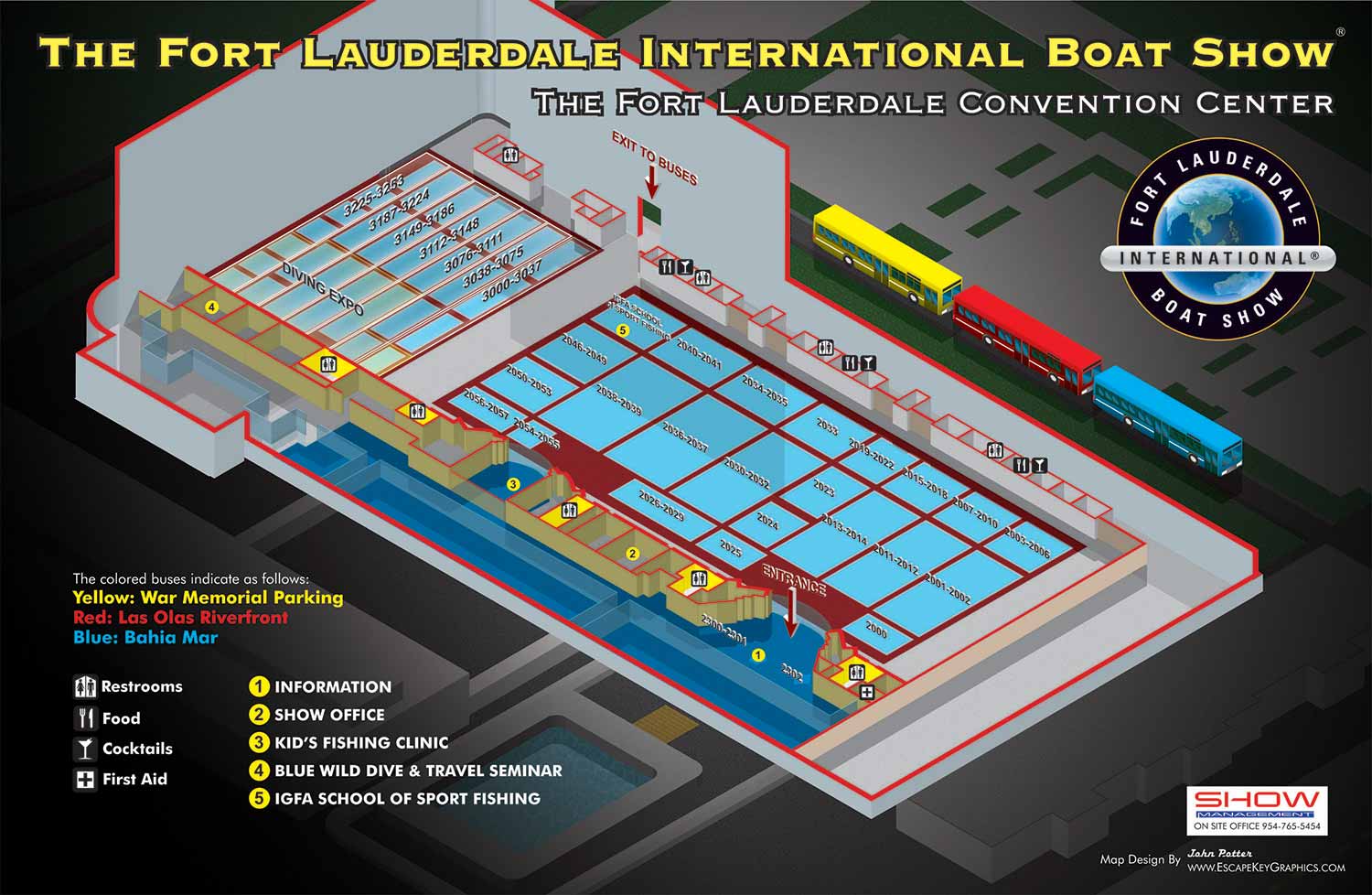
This axonometric cutaway illustration of the Broward County Convention Center represents my inaugural map for the Fort Lauderdale International Boat Show in 2010. As a foundational piece, it established design principles and a visual language that would evolve over more than a decade of collaboration with the event.
Created entirely as vector artwork within Adobe Illustrator, the map employed a deliberate aesthetic strategy. I used a dark background that faded gently towards the center, creating a subtle vignette effect that made the building itself appear to glow, drawing the viewer’s focus directly to the detailed interior layout. Surrounding buildings and parking areas were indicated with subtlety, ensuring they provided context without competing for attention.
The design prioritized clear, functional navigation for show attendees. A key feature was the illustration of bright, colored buses, each corresponding to specific shuttle routes. A dedicated key listed the destinations for these color-coded routes, simplifying transportation logistics for thousands of visitors. Within the convention center, exhibitor booth numbers were clearly marked, often as numbered spans to efficiently show large sections. Primary points of interest were highlighted with black numbers on bold yellow dots, while amenities like restrooms and information desks were indicated through simple, intuitive graphical icons.
This three-dimensional, axonometric style was a conscious choice at the time, representing an approach that felt detailed and premium to both myself and the client. While later years would see a shift towards flatter, more minimalist maps for improved clarity at a glance, this initial 3D view served its purpose in providing a comprehensive and engaging overview.
Produced alongside the main Bahia Mar show center map under an exceptionally tight deadline, this convention center illustration marked the beginning of a long-term partnership. It demonstrated how custom illustrative cartography could transform complex venue logistics into an accessible and visually coherent guide, setting the stage for years of iterative design and refinement for one of the world’s largest boat shows.
This was the first in a series of maps for this venue. To see how the design evolved in subsequent years, please explore other projects within my Map Portfolio.
Fort Lauderdale International Boat Show Maps:
- About Fort Lauderdale International Boat Show
- Bahia Mar, Swimming Hall of Fame & Las Olas Marina Maps: 2025 | 2024 | 2023 | 2022 | 2020 | 2019 | 2018 | 2017 | 2016 | 2015 | 2014 | 2013 | 2012 | 2011 | 2010
- Parking and Transportation Maps: 2026 | 2025 | 2024 | 2023 | 2022 | 2020 | 2019 | 2018 | 2015 Bus | 2015 Water Taxi | 2014 | 2013 | 2012 | 2011
- Broward County Convention Center Maps: 2026 | 2025 | 2024 | 2023 | 2022 | 2017 Sailfish Pavilion | 2017 | 2016 Sailfish Pavilion | 2016 | 2015 Sailfish Pavilion | 2015 | 2014 Sailfish Pavilion | 2014 | 2013 Sailfish Pavilion | 2013 | 2012 | 2011 | 2010
- 17th St Marinas Maps: 2026 | 2025 | 2024 | 2023 | 2022 | 2019 | 2016
- Show Directory Layouts: 2025 | 2024 | 2023 | 2022
- Video: 2013 54th Annual
- Illustrations (not maps): 2014A | 2014B
WHAT ARE AXONOMETRIC AND ISOMETRIC ILLUSTRATIONS?:
Axonometric and isometric drawings don’t have realistic perspective. I use specific mathematical formulas to draw this way. In these images things further away don’t appear smaller and therefore have equal weight of importance to things nearby. My axonometric maps and illustrations are generally bold and have a slightly cartoon like look. This method of rendering perspective is commonly used in technical and engineering drawings. I began using this method of drawing as an illustration tool in 2007.
The difference between isometric and axonometric is isometric drawings are really just from a straight on corner angle but axonometric drawings can be from other angles. Most of my illustrations have parts that are isometric, but are largely axonometric. I have a habit of calling them all isometric, but I shouldn't.


